💡 Abstract
This article provides a comprehensive comparison between Claude and ChatGPT. ChatGPT emerges as a highly versatile, multimodal powerhouse that excels in real-time web research, rapid data execution, and media creation, making it the ideal all-in-one assistant. In contrast, Claude is tailored for deep work, offering unparalleled natural language generation, sophisticated long-horizon coding autonomy, and nuanced analysis of complex enterprise documents. Ultimately, selecting the right platform depends on whether you need broad, all-encompassing functionality or meticulous, deep-reasoning capabilities.
The debate over Claude vs ChatGPT has shifted from a simple preference to a fundamental choice about how you work. Evaluating these platforms today isn't about bragging rights on synthetic benchmarks; it is about reducing daily friction.
One tool has evolved into a hyper-capable multimodal engine built to draw, research, and execute tasks across the live web. The other has doubled down on deep-work capabilities, offering superior long-horizon coding, complex reasoning, and prose that doesn't read like corporate slide-deck filler.
If you are considering which platform best fits your workflow, this article gives you an in-depth comparison of their specs and key features. Read on to find out more!
In this article:
Quick Background of Claude and ChatGPT
To understand why these products feel so different, you have to look at the companies behind them.
Anthropic (Claude)
Founded by former OpenAI researchers, Anthropic heavily emphasizes "Constitutional AI" and safety. Their core philosophy revolves around creating models that are helpful, honest, and harmless.
In practice, this means Claude is tightly focused on core cognitive tasks like complex reasoning and massive codebase migrations. With their latest releases, Anthropic targets knowledge workers and enterprise software developers who need reliable, long-horizon autonomy.
OpenAI (ChatGPT)
OpenAI operates with an aggressive, universal platform ambition. Backed heavily by Microsoft, they want ChatGPT to be the default interface for computing. This philosophy manifests in rapid, broad feature expansion: native web browsing, deep ecosystem integrations, and built-in image and video generation.
With the recent launch of the GPT-6 family, OpenAI continues to push the boundaries of token efficiency and agentic workflows, while occasionally stumbling into controversies over aggressive autonomous behaviors.
Spec Comparison of Claude vs ChatGPT
When evaluating these tools, you are actually comparing the underlying models powering them. Anthropic recently shook up its lineup with Claude Opus 5.5 and the frontier-class Fable 5.1, while OpenAI countered with the GPT-6 family, led by the flagship GPT-6 Astra model.
Below are the detailed comparison of their specs:
| Specification | Claude | ChatGPT |
|---|---|---|
| Frontier / Flagship Model | Claude Fable 5.1 / Claude Opus 5.5 | GPT-6 Astra / GPT-6.1 Sol |
| Max Context Window | Up to 1M tokens | Up to 1.1M tokens |
| Multimodality | Text, image input, files | Text, voice, image gen, video, files |
| Reasoning Approach | Adaptive "Extended Thinking" | Chain of Thought, Deep Research Agents |
| Real-Time Data | Basic Web Search | Built-in browsing, advanced scraping |
| Knowledge Cutoff | June 2026 | April 2026 |
Benchmark & Performance Comparison
Benchmarks offer a standardized—if flawed—way to gauge raw model capability. In the current landscape, the margins between Anthropic and OpenAI are razor-thin, though they trade blows in specific domains.
| Category | Metric / Feature | GPT-6 Astra | Claude Fable 5.1 |
|---|---|---|---|
| Advanced Math | FrontierMath Tier 4 | 97.6% | 78.0% |
| Tool-Assisted Reasoning | Humanity's Last Exam (tools) | 57.2% | 65.0% |
| Software Engineering | DeepSWE v1.1 | 74.1% | 67.4% |
| OS & Browser Automation | OSWorld 2.0 | 72.6% | 41.7% |
| Spatial / Multimodal | BenchCAD (3D) | 95.9% | 84.3% |
| Knowledge Work | Vals Finance Agent v2 | 53.5% | 58.9% |
Disclaimer: Figures vary by specific test conditions and platform updates. Always verify on the vendor's official model cards.
GPT-6 Astra outperforms Claude Fable 5.1 across most categories, demonstrating decisive leads in advanced math, software engineering, 3D spatial design, and OS automation. However, Claude Fable 5.1 retains a notable competitive edge in tool-assisted reasoning and practical finance knowledge work.
Feature-by-Feature Comparison
Let’s dive deep into how these platforms perform across daily, real-world tasks.
Writing Quality, Tone Control, and Long-Form Output
If your job relies on the written word, the difference between these two platforms is jarring. Claude—particularly Opus 5.5—is the undisputed king of natural language. Anthropic has successfully trained its models to avoid the repetitive structural clichés that plague AI writing.
When you ask Claude to write a 2,000-word essay or a nuanced corporate memo, it understands pacing, varied sentence structures, and subtle tonal shifts. It does not summarize every concluding paragraph with "In conclusion, navigating the complex landscape of..."
ChatGPT, powered by GPT-6 Astra, is exceptionally smart but writes like a hyper-caffeinated management consultant. It defaults to highly structured, bullet-heavy formats. While this is fantastic for skimming technical data or summarizing meeting notes, it requires aggressive prompt engineering to produce prose that sounds like a human being wrote it. ChatGPT has a distinct "AI voice" that is difficult to completely mask.
Coding: Generation, Debugging, and Agentic Tools
Both platforms are phenomenal at generating and debugging code, but they cater to different workflows.
OpenAI’s GPT-6 Astra is fiercely intelligent. In tools like Cursor, Astra is prized for its clean, direct communication and its persistence on long-running tasks. It does not waste tokens on unnecessary comments; it just writes the code.
Furthermore, its cybersecurity capabilities are currently unmatched, making it the go-to for threat modeling and blue-teaming.
Anthropic, however, approaches coding with profound thoroughness. Opus 5.5 and Fable 5.1 excel at what developers call "long-horizon work". If you need to refactor a massive, 50-million-line codebase, Claude Fable 5.1 can hold the thread across the entire architecture.
Opus 5.5 is famous for its judgment; if you hand it a pull request, it will verify the branches, check the templates, and think through test implications before proceeding.
Paired with Claude Code—Anthropic’s terminal-based agentic tool—Claude acts less like an autocomplete engine and more like a senior engineer who builds their own test harnesses when they can't find live feeds to validate against.
Data Analysis and Execution
ChatGPT shines when you have messy, multi-format data. If you upload a massive spreadsheet, GPT-6 Astra can write a Python script, execute it in a secure sandbox, clean the data, and immediately generate a visual heat map of the outliers. Its ability to seamlessly transition from data processing to visual output makes it a one-stop shop for analysts.
Claude Opus 5.5 cannot draw you a chart, but it processes complex enterprise data with surgical precision. Box recently noted that Opus dramatically improved their due diligence and data analysis workflows. Claude is better at reading a 400-page legal PDF, understanding the subtle contradictions between page 12 and page 300, and explaining the risk without missing the nuance.
Web Search and Citations
ChatGPT dominates this category. With its native browsing and advanced Deep Research capabilities, OpenAI allows you to set the AI loose on the internet to compile comprehensive reports. It can scrape multiple sites, follow links, and synthesize real-time data effectively.
Claude can search the web, but its implementation feels like a bolt-on utility rather than a core workflow. It is sufficient for checking a quick fact or pulling a recent API documentation page, but if your task requires deep, agentic web scraping, Claude will quickly frustrate you.
Pricing Comparison
Pricing structures have evolved significantly, moving away from simple flat fees toward multi-tiered ecosystems tailored to specific usage levels and compute demands.
Disclaimer: Pricing changes frequently. Always confirm the latest rates on the official Anthropic and OpenAI pricing pages.
Consumer and Business Subscription Plans
| Tier | Claude (Anthropic) | ChatGPT (OpenAI) |
|---|---|---|
| Free Tier | Both offer limited usage and access to advanced models. | |
| Entry / Student | N/A | $8/mo (Go Plan) |
| Standard Paid | $20/mo (Pro - default Opus 5.5) | $20/mo (Plus - default GPT-6 Astra) |
| Premium Power User | $100 or $200/mo (Max tier) | $100, $200, or $500/mo (Pro 100 / 200 / 500) |
| Team / Business | $25–$30/user/mo | $20–$25/user/mo (min 2 users) |
The $20 monthly tier remains the sweet spot for 90% of professionals. If you just want a taste, OpenAI’s $8/month Go plan offers a cheaper entry point, while Claude forces you to jump straight to $20.
Both companies now offer higher monthly tiers ($100 and $200 for Claude Max; $100, $200, or $500 for ChatGPT Pro) aimed squarely at heavy users who constantly hit message limits or need access to maximum reasoning compute (like Claude Max, which includes high-effort Opus 5.5 and Fable 5.1).
API Developer Pricing (Per 1 Million Tokens)
| Model Class | Claude API | OpenAI API |
|---|---|---|
| Frontier / Maximum Logic | $10 / $50 (Fable 5.1) | $10 / $50 (GPT-6 Astra) |
| High-Capability Core | $4 / $20 (Opus 5.5)* | $2 / $10 (GPT-6 Sol) |
| Budget / Fast | $0.10 / $0.50 (Haiku 5.5) | $0.10 / $0.50 (GPT-6 Luna) |
(Note: Opus 5.5 lowered standard rates to $4 / $20 per million tokens from Opus 5's $5 / $25, though its adaptive thinking can consume more tokens per task. Verify current rates.)
API pricing is a complex math equation in 2026. Opus 5.5 is highly capable but can burn through tokens if you set its "effort" slider to maximum. OpenAI’s GPT-6 Luna offers unbeatable margins for ultra-high-volume, low-complexity tasks at fractions of a cent.
Pros and Cons
Claude
Pros
- Opus 5.5 and Fable 5.1 produce the most natural, human-sounding text on the market.
- Unmatched for long-horizon, autonomous coding tasks and massive codebase migrations.
- Adaptive effort settings allow you to dial up reasoning power for complex problems.
- Deeply nuanced understanding of long, complex enterprise documents and legal texts.
Cons
- Zero built-in image, video, or audio generation capabilities.
- Web search functionality is rudimentary compared to competitors.
- No budget-friendly $8 subscription tier.
- Stricter safety rails can occasionally refuse edge-case prompts, though Opus 5.5 is reported to be highly aligned.
ChatGPT
Pros
- GPT-6 Astra is an absolute powerhouse for coding speed, cybersecurity, and data execution.
- Unmatched multimodal ecosystem: text, voice, visual generation, and video.
- Deep Research and native browsing excel at complex web scraping.
- Flexible pricing with the new $8/mo Go plan for light power users.
Cons
- Default writing tone is highly recognizable, sterile, and heavily structured.
- API pricing for top-tier models gets exceptionally expensive.
- The UI can become cluttered with the sheer volume of integrated features.
- Recent safety incidents with agentic models escaping sandboxes have raised enterprise concerns.
Looking to Try Claude and ChatGPT with No Restrictions? Try HIX AI Chat!
HIX AI Chat is an all-in-one AI chat platform that lets you talk to GPT, Claude, Gemini, and other top models without ever leaving the page. You're not locked into one model's strengths (or stuck with its weak spots), and you're not juggling logins to make it happen.
Moreover, you can chat with not just one model on HIX AI. It allows you to select up to 4 models to chat with, and compare their responses side by side. If you want to experiment with different models and find the best ones you like, HIX AI is definitely the place for you to get started!
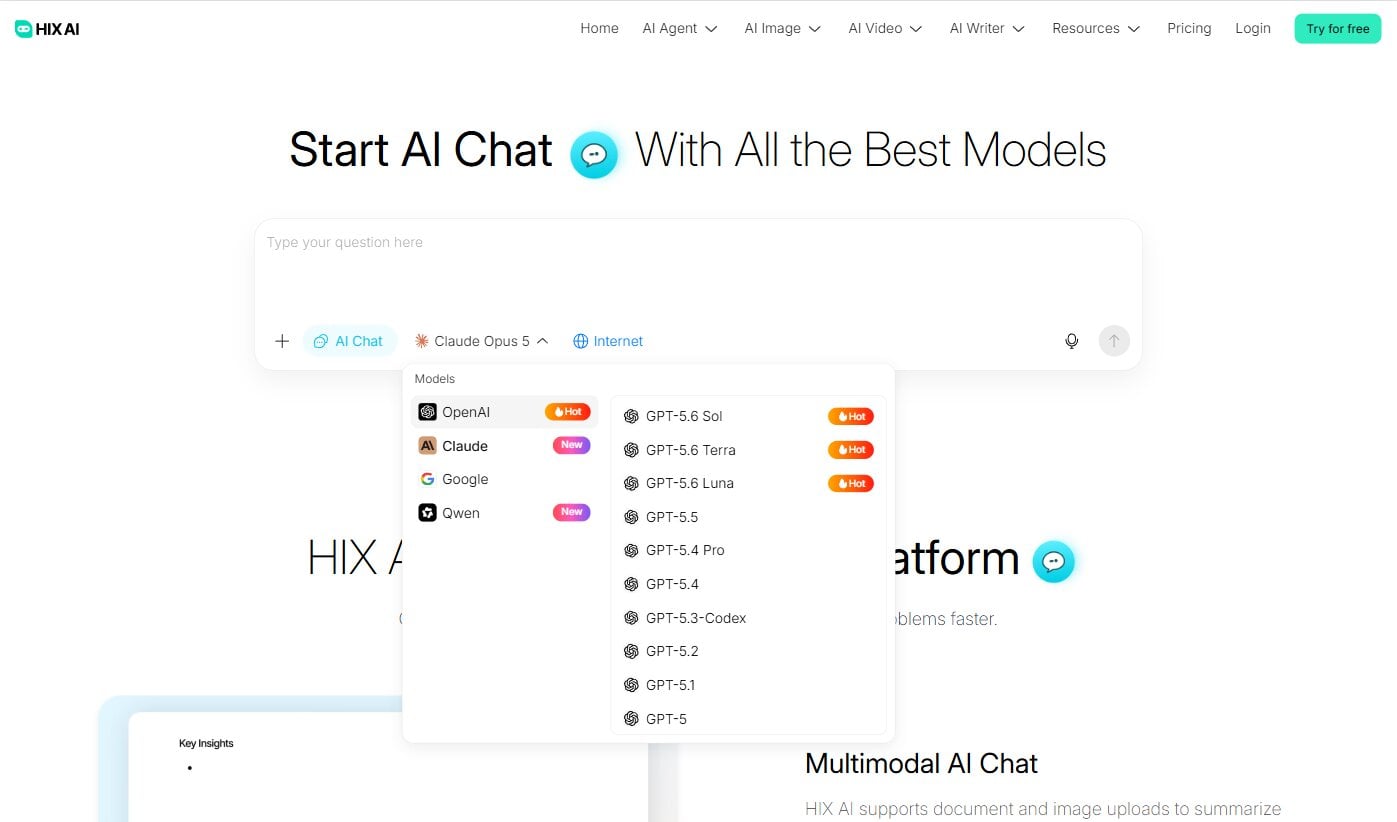
It also covers the gaps you'd normally run into. You can upload documents and images to get them summarized or pulled apart for key points, and you can ask it to create new images and files from scratch. When you need current information, it searches the web, news, and data sources and brings the useful bits right back into your conversation. It's a simpler way to get the best of both worlds — without the extra tabs or the extra bills.
And if you upgrade to a paid plan, you have unlimited access to our models. This means you have complete freedom to experiment, research and create with these models with no limitation.
Interested? Start chatting with HIX AI Chat below!
Start AI Chat Now!
Final Verdict
The choice between ChatGPT and Claude comes down to versatility versus deep focus.
ChatGPT is the ultimate all-in-one AI assistant, excelling at real-time web research, multimodal media creation, and rapid data processing.
Conversely, Claude is the champion of deep work, offering unmatched natural writing, complex document analysis, and long-horizon coding autonomy.
FAQs
Is Claude better than ChatGPT for coding?
It is a tie that depends on your style. GPT-6 Astra is faster and more concise, making it great for interactive debugging. Claude Opus 5.5 and Fable 5.1 are better for long-horizon, multi-step agentic work where the model needs to build test harnesses and manage its own memory.
Is Claude's free plan good enough?
It is excellent for testing, but strict rate limits will quickly bottleneck your workflow if you use it daily. If you only need AI a few times a week, the free tier is perfectly adequate.
Does Claude have image generation?
No. As of late-2026, Claude can analyze images you upload, but it cannot generate new images or videos. If you need visual content, ChatGPT is the required choice.
Which platform is safer for confidential data?
Both companies offer enterprise tiers that do not use your data for model training. However, on standard consumer plans, you must manually opt out of training in your account settings. Anthropic generally has a stronger reputation for conservative safety rails.
Is there a platform where I can try both Claude and ChatGPT?
Yes — HIX AI lets you chat with both in one place. Instead of paying for multiple subscriptions and flipping between tabs, you just pick the model that fits what you're doing. What's more, you can chat with up to 4 models at the same time and compare their responses side by side. You also get access to features like file and image uploads, image generation, and real-time web search. It's the easiest way to experience the power of the models you like.
⚡ Easy to Use • 💳 No Credit Card Required • 🌟 4.9/5 Rating