💡 Abstract
This article compares the practical strengths and weaknesses of Google Gemini and OpenAI's ChatGPT. While ChatGPT stands out as an autonomous agent built for deep reasoning and complex coding, Gemini excels at massive context windows and seamless Google Workspace integration. The piece explores feature benchmarks and shared limitations—like hallucinations and rate throttling—ultimately recommending that users test both tools side-by-side on a unified platform like HIX AI Chat to find the best fit for their specific workflow.
Google Gemini and OpenAI's ChatGPT are two widely used AIs in the world, and for most people, the answer to "Google Gemini vs ChatGPT, which one should I choose?" isn't obvious.
The real differences are practical ones. Gemini is built into your Google apps. ChatGPT has strong reasoning capabilities. Each has strengths the other doesn't.
This comparison breaks down how the two assistants perform across writing, reasoning, coding, multimodal input, integrations, privacy, and pricing — so you can pick the one that fits your actual work.
In this article:
TL;DR
If you just want the final answer before diving into the benchmarks and feature tests, here is exactly how the two platforms diverge right now.
ChatGPT focuses on complex multi-step reasoning, robust coding agents, and precise source control during research. Google Gemini focuses on massive context windows, seamless multimodal integration, and embedding itself directly into your daily workspace.
Both OpenAI and Google offer brilliant tools, but they solve different problems. OpenAI built an autonomous, highly capable agent designed to tackle hard tasks independently. Google built an omnipresent assistant designed to synthesize massive amounts of data inside the software you already use.
Quick Comparison Table of Google Gemini vs ChatGPT
Here is the at-a-glance overview of how the two platforms stack up.
| Feature | Google Gemini | ChatGPT |
|---|---|---|
| Maker | OpenAI | |
| Current Flagship Model | Gemini 3.8 Flash | GPT-6 Astra, GPT-6.1 Sol |
| Context Window | Up to 1,000,000 tokens | Up to 1,000,000 tokens |
| Web Access | Yes | Yes |
| Multimodal Inputs | Text, audio, video, image, PDF | Text, audio, image, PDF |
| Image Generation | Nano Banana 2.1 | GPT Image 2.5 |
| Code Execution | Yes | Yes (Advanced Data Analysis) |
| Best-Known Strength | Workspace integration & massive context | Deep reasoning & coding agents |
The Model Lineup of Google Gemini and ChatGPT
To understand the products, you have to understand the models powering them.
Google's Gemini 3.x Family
Google structures its models around the "Flash" and "Pro" naming conventions, prioritizing efficiency and multimodal data ingestion. The free tier gives you unlimited access to Gemini 3.6 Flash, alongside a limited daily quota of the more capable Pro model. Upgrading to the Google AI Pro plan unlocks higher limits for Gemini 3.1 Pro.
Google continues to rapidly iterate on its Flash tier. While Gemini 3.7 Flash launched in August 2026 as a strong model for coding and agents, Google recently released Gemini 3.8 Flash in September 2026 as its latest general-purpose model. Gemini 3.8 Flash combines advanced reasoning with Flash-level speed. Every Gemini 3 model natively understands audio, video, text, and images.
Google builds these models from the ground up to understand audio, video, and text natively in the same embedding space, avoiding the latency of translating speech to text before processing it.
OpenAI's GPT-6 Family
The current lineup of ChatGPT relies on the newly launched GPT-6 family, introduced in September 2026. This supersedes the older GPT-5.5 and GPT-5.6 models, trading cost against capability across three tiers: Astra, Sol, and Luna. Free and Go users now default to GPT-6 Luna in the desktop app, which is a fast, cheap model designed for everyday chat and simple Q&A.
The flagship model is GPT-6 Astra, released on September 3, 2026, which boasts a massive 1.05-million-token context window and can output up to 128,000 tokens. ChatGPT Plus subscribers can access GPT-6 Astra through ChatGPT Work and Codex, alongside GPT-6 Sol for creative work. If you require maximum compute, OpenAI's Pro ($200/month), Business, and Enterprise tiers unlock GPT-6 Astra (also called Astra Pro) directly in Chat.
Feature-by-Feature Comparison of Google Gemini and ChatGPT
Spec sheets do not fully explain how an AI behaves. To see how these architectural differences play out under pressure, we tested both platforms across real-world workflows to see where they excel, where they break, and who takes the crown in each category.
Reasoning & Complex Problem Solving
OpenAI explicitly built the GPT-6 generation for demanding end-to-end work and complex reasoning. GPT-6 Astra excels at advanced mathematics, deep research, and scientific work. Gemini's Gemini 3.1 Pro utilizes a thinking architecture to manage tough problems internally. However, Astra's capabilities remain highly formidable in multi-step logic.
Gemini 3.1 Pro and the newer 3.8 Flash model also feature thinking modes, but they struggle to maintain consistency over highly abstract logic puzzles compared to Astra. When you ask an AI to solve a hard math problem or untangle a messy logic paradox, ChatGPT feels distinctly more rigorous and methodical.
Writing Quality and Tone Control
Both platforms have largely moved past the robotic, overly verbose tone that plagued early AI. ChatGPT provides tools like Canvas, which allows you to highlight specific sentences and ask the AI to rewrite them, adjust the length, or change the tone.
Gemini counters with native integration into Google Docs, allowing you to generate and revise text directly where you work. Gemini tends to sound slightly more natural and conversational out of the box, whereas ChatGPT's GPT-6 Sol is highly recommended as the best tier for writing and creative work.
Coding and Developer Workflow
For developers, ChatGPT retains a clear edge. GPT-6 Astra dominates coding benchmarks and acts as a highly capable desktop agent. Astra shines in long-horizon agentic tasks that involve computer and browser use, security research, and binary reverse engineering.
Gemini is no slouch; the recent Gemini 3.7 and 3.8 Flash models provide strong, affordable workflows for everyday coding and business automation.
Web Search, Citations, and Factual Grounding
Google Search is the backbone of the internet, and Gemini uses it natively. When you ask Gemini about a recent news event, it pulls accurate, up-to-date data faster than ChatGPT and surfaces highly relevant links.
While ChatGPT relies primarily on Bing, it actually uses a hybrid system of its own crawlers and third-party fallbacks. Because of this patchwork, ChatGPT occasionally struggles to parse complex, real-time data feeds as cleanly as Gemini does. Google also leverages its Knowledge Graph, allowing Gemini to cross-reference entities and facts with a higher degree of initial accuracy.
Image Generation
The Gemini app includes Nano Banana models for high-fidelity image generation. ChatGPT Plus counters with GPT Image 2.5 for image. Gemini's media tools feel slightly more cohesive, especially because Gemini's core API natively accepts audio and video inputs without converting them to text first.
Benchmark Comparison of Gemini vs ChatGPT
Raw intelligence metrics only tell part of the story, but they remain the best standardized way to measure capability. Here is how the flagship models of Gemini and ChatGPT perform on industry-standard evaluations.
| Benchmark | Evaluation Metric / Focus | Google Gemini (Gemini 3.1 Pro / 3.8 Flash) | ChatGPT (GPT-6 Astra) |
|---|---|---|---|
| Artificial Analysis Intelligence Index | Composite multi-domain intelligence | 56 | 58 – 60 |
| GPQA Diamond | Graduate-level scientific reasoning | 94.6% | 96.1% |
| ARC-AGI-2 | Novel abstract reasoning & pattern synthesis | 84.6% | 95.0% |
| FrontierMath (Advanced Math) | Research-grade mathematical problem solving | ~81.2% | 97.6% |
| Terminal-Bench 4.0 | Autonomous CLI & shell agent workflows | 85.8% | 89.5% |
| SWE-bench Verified / Pro | End-to-end GitHub issue resolution & debugging | 65.2% | 73.8% |
| OSWorld 2.0 | Desktop GUI interaction & computer use | 47.9% | 62.6% |
| ExploitBench | Cybersecurity vulnerability identification & exploitation | 88.0% | 100.0% |
You should look at these numbers with a healthy dose of skepticism. Benchmarks mislead. The AI industry suffers heavily from "contamination," meaning the questions used in these tests often accidentally end up in the training data of the models. When a model scores well, it is sometimes hard to tell if it reasoned its way to the answer or simply memorized the test during training.
Where Each One Still Falls Short
Neither AI is perfect. Both platforms suffer from severe lock-in risks, frustrating compute quotas, and the stubborn persistence of hallucinations.
The Hallucination Problem
Both models still hallucinate facts. This becomes glaringly obvious when using Deep Research. OpenAI warns that its GPT-based Deep Research occasionally makes factual errors and incorrect inferences.
Gemini faces the exact same problem. If you ask either tool to generate a 15-page legal summary, you must verify the citations manually. They will confidently synthesize two unrelated sources to draw a conclusion that sounds plausible but is entirely false.
The models are increasingly good at citing real websites, but they often misinterpret the text on those websites.
Rate Limits and Throttling
If you rely heavily on AI, you will hit rate limits. Google abandoned fixed message caps in favor of a compute-based model. This means a complex Gemini request (like running a massive multimodal query) drains your unseen compute quota much faster than asking a simple text question, leading to unpredictable throttling.
OpenAI is more transparent but restricts power users heavily. The standard ChatGPT Plus plan limits you to roughly 10 full Deep Research runs and a fixed number of reasoning queries per month. If you need more, OpenAI forces you into the $100 or $200 Pro tiers, which most individuals simply cannot justify.
Ecosystem Lock-In
Google explicitly designed Gemini to operate within Google Workspace. If you use Microsoft Office or independent text editors, adopting Gemini means you lose out on half of its value, since you cannot use it natively outside of Gmail, Docs, and Drive.
OpenAI, conversely, wants to be your entire operating system. By routing your web search, image generation, and document writing through the ChatGPT interface, OpenAI creates a walled garden. This strategy makes it painful to export your data and switch to a competitor later.
Try Both Gemini and ChatGPT on HIX AI Chat
Stop guessing which model fits your work — test them both on one platform. HIX AI Chat puts GPT, Gemini, Claude, DeepSeek, and other leading models in a single workspace, so switching between them takes one click instead of a second subscription and a second set of rate limits. And instead of chatting with just one model, HIX AI Chat allows you to select up to 4, talk to them all at once, and compare their responses seamlessly.
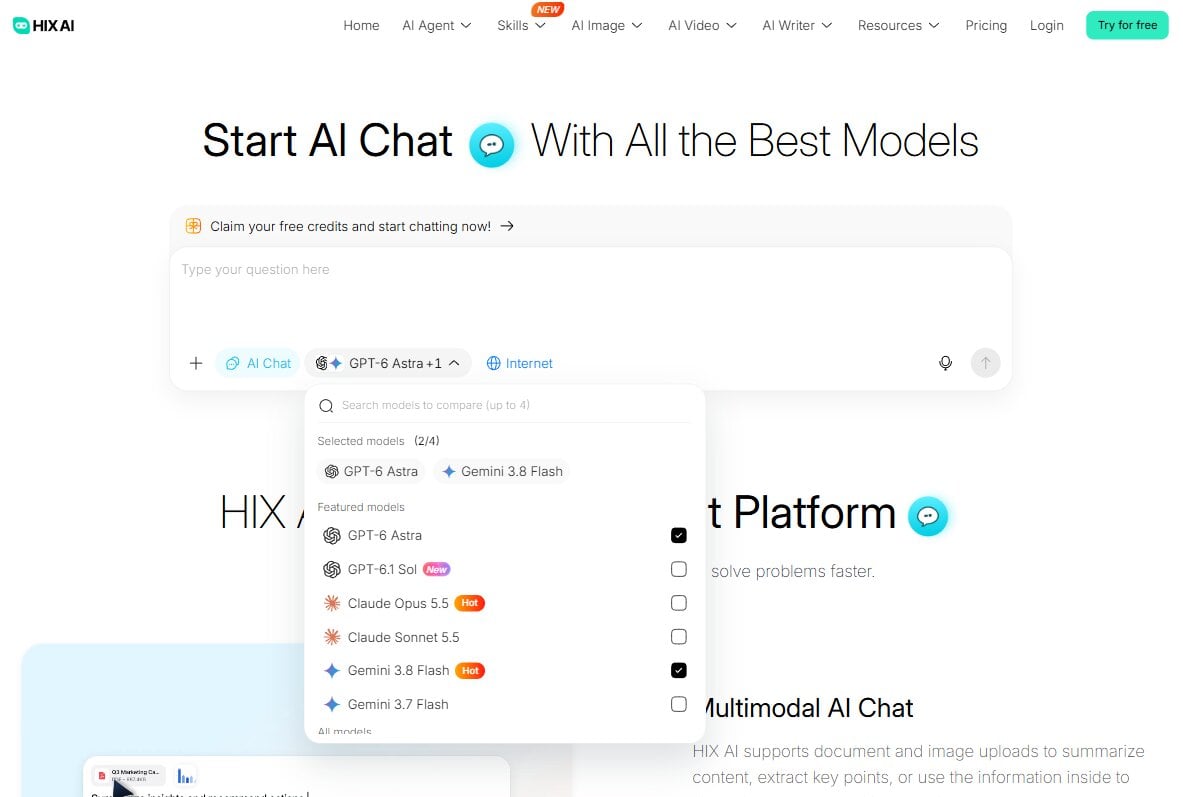
On HIX AI Chat, you can also upload documents and images to summarize content, extract key points, or feed better context into your questions. And when you need current information, HIX AI searches the web, news, and analytical data sources and brings the relevant details straight back into the conversation.
Start chatting on HIX AI today and find your best model in minutes, not months.
Try HIX AI Chat
Conclusion
The choice between Gemini and ChatGPT rarely comes down to raw intelligence. Try both extensively. Figure out how smooth you can access these models and which one works best for your task.
And you don't have to pay twice to do it. HIX AI Chat puts all leading models in a single workspace, so you don't have to juggle between tabs to try them. Enjoy an all-in-one, smooth and seamless AI chat experience on HIX AI.
⚡ Easy to Use • 💳 No Credit Card Required • 🌟 4.9/5 Rating